
Read time: 8 minutes
Rukham Masood Khan
A passenger checks the app before she leaves home. Flight on time, gate to be confirmed. Two hours later she is at the far end of the terminal with a coffee. Her gate has changed. The only announcement is a loudspeaker she can barely hear.
She is far from unusual. In a 2025 study for the UK Civil Aviation Authority, 92% of passengers said they check their flight's status before going to the airport. Yet more than two in five first found out about their disruption from airport screens or speakers.
This guide follows the journey of messages that support a passenger through the day of travel, from check-in to the baggage carousel. It covers what to send, when and on which channel. It also shows why this matters for an airline's costs and customer relationships.
Why the day of travel needs its own rules
Airline messages can land at any point in a day. On the day of travel, the value of a message depends heavily on when it arrives. A gate change that reaches a passenger after the gate has closed is no help to them. It only shows that the airline knew and did not tell them in time.
Timing also has a price attached. A 2021 study in the Journal of Service Research tested how passengers react to being offloaded from an overbooked flight. Those told before they left for the airport accepted compensation of about 5% of the legal amount. Those told once they were on the plane wanted up to 500%. Early warning lowered the compensation needed. In the researchers' simulation, that let airlines overbook more and raise net revenue by up to 1.3%.
That study looked at denied boarding, but the CAA research points the same way for everyday disruption. Among passengers unhappy with their airline's communication, 36% tried to claim compensation. Among satisfied passengers, it was 27%.
One practical consequence follows from all this. Every day-of-travel message should be timed against the latest estimated departure time, not the schedule. If a flight is 40 minutes late, every message about it accomodate that change.
Gates and boarding
You usually have 5 types of notifications related to boarding gates: the gate is assigned, the gate has changed, boarding is open, final call, and a reminder to anyone who has checked in but not yet boarded. Each needs an automatic trigger from departure control. Gate changes also need a manual trigger. The most disruptive ones happen at the last minute, when a stand is reassigned or an aircraft swaps.
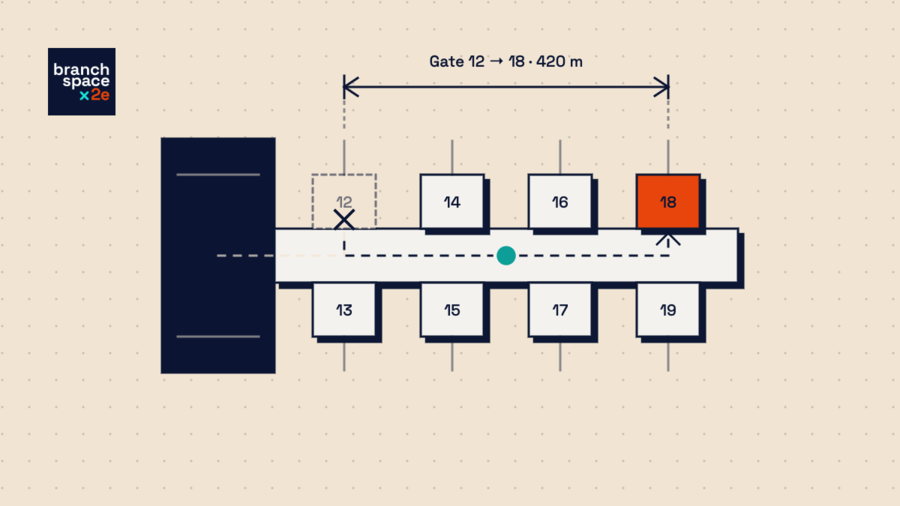
The CAA report warns against gate changes and boarding alerts that arrive without warning. The risk is highest at large hubs. Gates there are far apart, and disabled passengers and families with young children struggle to move quickly. A gate change message should give the passenger what they need to act:
the new gate
the walking time where it is known
and whether boarding has started
The phone's lock screen comes into play as well. A boarding pass stored in Apple Wallet or Google Wallet can be updated in place, so the new gate appears without the passenger opening anything.
Consistency is the harder problem. Passengers in the CAA study said airline apps and emails were often slower than the airport screens, or contradicted them. So they went back to watching the departure boards. The fix is to send every channel from the same event: the passenger's message, the app, the call centre's view, the gate agents and the crew should all show the new gate at the same moment.
Queues, roads and the unexpected
Some of the most useful messages on the day have no system trigger at all. Think of a strike, a flooded road or a long security queue. The operations team writes these messages themselves. They choose which flights, routes or dates receive them.
These need to go out in minutes, without waiting on an IT ticket. In September 2024, one airport terminal was under renovation. An airline we work with sent every passenger departing from it a daily reminder to arrive early. It ran for three weeks and reached between 10,000 and 20,000 passengers a day.
A queue warning is also a reasonable place for an offer. A passenger told to allow an extra 30 minutes for security has a reason to buy fast track there and then. Priority bag drop works the same way on a busy morning.
Bags
Baggage handling has improved sharply, but loosing bags is still expensive. According to SITA's 2026 Baggage IT Insights report, mishandling rates fell 23% in 2025, yet 24 million bags were still mishandled. Each one costs an average of $260. Net profit averages $8 a passenger, so a single mishandled bag cancels out the profit on more than 30 seats.
The same report shows where the cost are incurred. Transfers caused 39% of mishandled bags in 2025. Delayed bags make up around 70% of the total cost, mostly for recovery, rerouting and delivery. Well timed messages can mitigate this.
The data to drive those messages is arriving. Baggage tracking under IATA Resolution 753 now covers more than half the industry, with full compliance targeted for 2027. Half of airlines plan to give passengers real-time baggage updates. Passengers want them: in SITA's 2025 passenger survey, 78% said they would pay for end-to-end tracking.
Start by telling the passenger their bag is on board. When a bag misses a connection, tell the passenger while they are still in the air or walking to reclaim. Give them the bag's new flight and a pre-filled link to report it and add a delivery address. Without it, the passenger finds out at an empty carousel and then joins a queue. Delivery updates follow until the bag is back with its owner.
In the US there is a regulatory reason as well. The Department of Transportation's automatic refund rule requires airlines to refund bag fees when checked bags are significantly delayed, alongside refunds for cancelled and significantly changed flights.
Wheelchairs and mobility devices
Passengers who travel with a wheelchair need to know it is on board before take-off. Under a US Department of Transportation rule finalised in December 2024, airlines must tell passengers whether their wheelchair or scooter is on board before the cabin door closes. That includes telling them when it could not fit. Before passengers leave the aircraft, they must be told when it has been unloaded.
Both deadlines fall at moments when the passenger can still act. That makes them good triggers for an automated message, so a busy gate agent does not have to remember. The CAA study gives another reason for care. Passengers with disabilities were less satisfied with how disruption was first communicated (28% against 35%). They also rely on a wider mix of channels, including staff in person.
Getting the detail right
The CAA research shows what passengers want from a disruption message. Each finding translates into a setting an operations team can configure.
1. Lead with the new time
When first told about a disruption, passengers most want the new time. 81% put the length of delay or new flight time in their top five, and 44% ranked it first. The reason for the disruption came second, in the top five for 61%.
2. Say when the next update will come
43% of passengers want an update every 30 minutes, even when nothing has changed. Another 27% want one every 15 minutes. A hold window prevents the opposite problem: three updates in five minutes while an estimate moves.
3. Choose the channel by moment
64% of passengers preferred SMS for the first notice of a delay. It works abroad without data or Wi-Fi. None of the main passenger groups in the study ranked airline apps among their top two channels for that first message. Apps, push and WhatsApp suit routine updates and anything with a link. Email suits cancellations, where passengers want a record.
Cost belongs in the rule too. Since July 2025, WhatsApp charges per message. Utility messages sent while a customer service conversation is open are free.
4. Write for 70 characters
A standard SMS holds 160 characters in Latin script. One character outside that set cuts the limit to 70. Chinese, Japanese, Korean, Arabic and Thai all fall outside it. A gate change in any of those languages has to work in one short line.
5. Make it look genuine
Passengers in the CAA study worried about scam texts. A flight number, the passenger's name and a sender ID they recognise all help.
6. Keep a pause button
When the picture is unclear, an operations team should be able to hold outgoing messages for a flight or a whole airport rather than send something it will have to correct.
7. Day-of-travel messages at a glance
From messages to orders
Today most of these messages are triggered by changes to a booking record or a departure control event. The industry's move to Offer and Order changes where those signals come from. IATA's NDC standard already includes an order change notification for involuntary changes, and ONE Order defines messages for service delivery and service status changes. In that model, a passenger boarding or a bag being loaded becomes an event on the order. A notification layer built on events carries over without a rebuild.
The scale is already proven. Across the airlines we work with, our platforms send more than 1.6 billion passenger, ground staff and crew notifications a year.
Back to the passenger with the coffee. This time her phone buzzes as the gate changes. The message gives her the new gate, an eight-minute walk and a boarding time 25 minutes away. The gate team saw the change when she did. Her app shows her bag is on board.
Talk to us about the messages your passengers get on the day of travel.